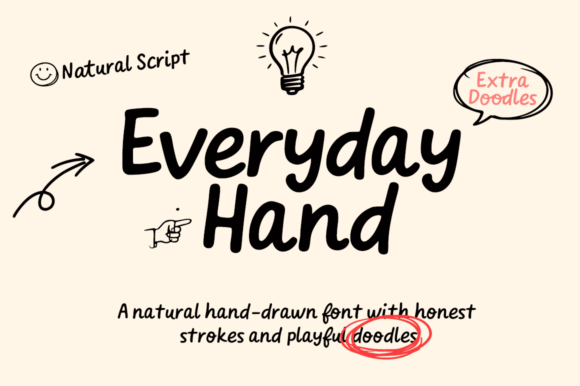
Everyday Hand: Your Go-To Font for Authentic, Friendly Design
There's a specific kind of charm in handwriting that feels real. It’s not the perfectly slanted, uniform cursive of a wedding invitation, but the relaxed, confident script of a quick note or a personal journal entry. This is the essence captured by Everyday Hand, a natural handwritten font designed to bring warmth, approachability, and a distinctly human touch to your creative projects. It’s a typeface that doesn’t strive for perfection, and in doing so, achieves a more relatable and authentic kind of beauty.
Understanding the Anatomy of a Natural Handwritten Font
What makes a font like Everyday Hand feel so different from a standard script or a casual sans serif? The answer lies in its subtle, intentional details. The letterforms are built on soft, slightly varied strokes that mimic the pressure of a pen on paper. You’ll notice an organic flow to the baselines and x-heights, avoiding the rigid uniformity of many digital fonts. This slight inconsistency is its greatest strength, creating a visual texture that feels genuine and lived-in.
The personality of Everyday Hand is decidedly casual, yet it never sacrifices clarity. The characters are designed to be highly legible, even at smaller sizes, making it a versatile workhorse. It’s a font that whispers rather than shouts, making it ideal for projects where you want the content to connect with the audience on a personal level. Often, this style of premium font includes a set of hand-drawn doodle elements—swashes, arrows, or simple illustrations—that allow you to extend that playful, crafted feel throughout your designs.
Where Everyday Hand Truly Shines: Practical Applications
The true value of a creative font is measured by its utility. Everyday Hand is not a one-trick pony; its friendly demeanor adapts seamlessly across a surprising range of contexts. For brand identity, it’s a game-changer for small businesses, artisans, and lifestyle brands. Imagine it on a coffee shop menu, the label for a small-batch jam, or the branding for a yoga studio. It instantly communicates a commitment to craft, care, and a personal touch.
In the world of editorial design and publishing, this handwritten font excels at creating inviting chapter headings, pull quotes, or annotations that feel like a thoughtful note in the margin. Bloggers and content creators find it indispensable for social media graphics, where its friendly vibe can increase engagement and make a message feel more conversational. It’s equally at home in digital spaces like web design—think of a testimonial section or a call-to-action button that feels more personal—and in print projects such as wedding invitations, greeting cards, and planner stickers.
Making the Choice: Pairing and Practical Considerations
Choosing the right font is a strategic decision. To determine if Everyday Hand is the right fit, consider your project’s primary goal. Is it to convey warmth, informality, and human connection? If yes, it’s a strong candidate. However, for long blocks of body text or highly technical information, its handwritten nature can become fatiguing. This is where the art of font pairing comes into play.
A successful pairing often involves contrast. Everyday Hand works beautifully alongside a clean, geometric sans serif font for body copy, allowing the handwritten elements to stand out for headings and accents. For a more classic or sophisticated look, pairing it with a sturdy, traditional serif font can create a compelling hierarchy. The handwritten font provides the personality, while the companion font delivers stability and readability for the main text.
When evaluating this commercial font, take the time to review all included styles. Does it offer multiple weights or alternates? Do the included doodle elements align with your project’s theme? Always test the font at various sizes within your actual design to check for readability. Finally, ensure you understand the licensing. For any commercial project—from packaging design to a client’s logo design—confirming the font’s license permits such use is a non-negotiable step in professional practice.
Ultimately, Everyday Hand is more than just a collection of glyphs. It’s a design asset that injects personality. It’s a tool for telling stories that feel intimate and genuine. By understanding its character and applying it thoughtfully, you can create designs that don’t just look good, but feel wonderfully, authentically human.